


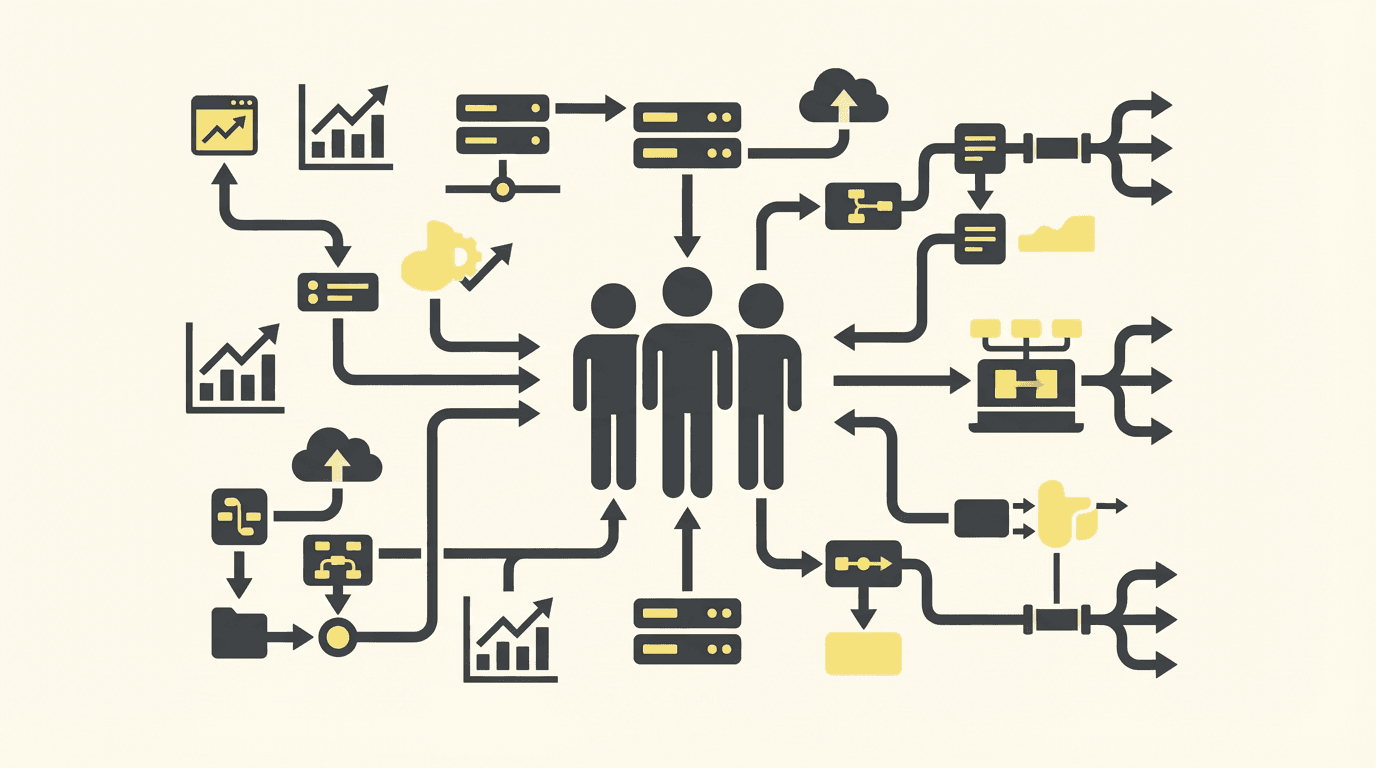
The most important marketing org chart question in 2026 isn't headcount.
It's: which functions can a single person run with agents behind them?
A 3-person marketing team with the right AI stack can now out-execute a 12-person team that's still running on meetings, briefs, and approval chains. This isn't a prediction -- it's happening at companies right now, and the gap between them and their slower competitors is widening every quarter.
The reason is simple: the bottleneck in marketing was never talent. It was always coordination overhead.
Why Bigger Teams Don't Win Anymore
Traditional marketing org design was built around human bandwidth constraints. You needed a campaign manager to build the campaign, an analyst to report on it, a coordinator to keep everything on schedule, a specialist to run each channel, and a manager to align them all.
Every handoff was a delay. Every meeting was a synchronization cost. Every approval chain added days.
Scaling that model meant hiring more people to handle more campaigns across more channels. The relationship between headcount and output was roughly linear.
AI agents break that relationship entirely.
According to Microsoft's 2026 AI trends report, AI agents will act more like teammates than tools in 2026 -- handling execution autonomously while humans focus on strategy and oversight. The teams adopting this model aren't replacing people. They're rebuilding how work gets done.
The Functions That AI Agents Handle Now
The functions that consumed most of a marketing team's operational bandwidth are exactly the ones AI agents handle well: structured, repetitive, measurable, and data-driven.
Campaign execution and optimization
An AI agent can launch a campaign, monitor performance in real time, shift budget between ad sets based on ROAS thresholds, pause underperforming creative, and generate a performance summary -- all without a human in the loop. What used to require a campaign manager checking dashboards three times a day now runs continuously.
Reporting and analytics
The average marketing analyst spent 70% of their time pulling data from multiple platforms, cleaning spreadsheets, and building reports. That work is now handled by automated workflows that pull data continuously, normalize it across platforms, and surface plain-English insights on a schedule. With Toffu's scheduled tasks, you can set up automated weekly reports to Slack or email in minutes -- no code required.
Content scheduling and publishing
Blog posts, LinkedIn updates, email sequences -- all of these can be planned, written (with human oversight), and scheduled to go live automatically. The daily blog task that once required a content manager is now a workflow that runs at 9am every weekday.
SEO and keyword monitoring
Tracking keyword rankings, identifying new opportunities, auditing internal links, monitoring competitor content -- these are agent tasks. They don't require creative judgment. They require consistent execution against a defined ruleset.
Lead routing and CRM hygiene
Deduplicating records, updating lifecycle stages, routing leads to the right sequence, flagging data anomalies -- these are the operational tasks that used to require a CRM administrator. AI agents handle them continuously.
What This Looks Like in Practice
Here's the difference between a traditional 12-person marketing team and a 3-person team running with AI agents:
The 12-person team
- Monday morning standup to align on priorities
- Campaign manager spends Tuesday briefing the designer and copywriter
- Wednesday: waiting for approvals
- Thursday: campaign launches, 2 days late
- Friday: analyst pulls the performance report manually
The 3-person team with agents
- Campaign brief written Monday, agent generates copy variants and schedules for review
- Tuesday: campaign launches after 10-minute human review
- Wednesday: agent sends automated performance summary to Slack
- Thursday: agent identifies underperforming ad set and reallocates budget
- Friday: human reviews the week's insights and plans next week's strategy
The 3-person team ships faster, optimizes continuously, and the humans on it spend their time on strategy and creative direction -- the work that actually requires judgment.
The Functions That Still Require Humans
This matters as much as knowing what agents can do.
Strategy and positioning: Deciding what to say, to whom, and why -- that's still a human job. An agent can generate content, but it can't decide whether your positioning is differentiated or whether your message resonates with the specific buyers you're targeting.
Creative direction: The judgment about whether a creative concept is good, whether the brand voice is right, whether the angle will land with the audience -- humans. Agents can produce variations. Humans decide which direction is worth pursuing.
Relationship-driven work: Enterprise sales cycles, partnership conversations, customer success calls -- anything that requires building trust with another human is outside what agents do well.
Novel problem-solving: When something unexpected happens -- a campaign tanks for no obvious reason, a competitor makes a surprise move, a market shifts -- the strategic response requires human judgment. Agents can surface the data. Humans decide what it means.
The lean team model doesn't eliminate the need for marketers. It eliminates the need for marketers to spend most of their time on execution tasks that don't require their judgment.
How to Rebuild Your Marketing Team Around This Model
The shift isn't about cutting headcount. It's about restructuring how work gets done.
Step 1: Audit where your team's time actually goes
Most marketing teams, if they tracked their time honestly, would find that 60-70% of it goes to execution and coordination: briefing, reviewing, scheduling, reporting, updating spreadsheets. These are the functions to automate first.
Step 2: Map your workflows to agent capabilities
For each high-time-cost function, ask: is this structured enough that an agent could handle it with clear inputs and rules? If yes, it's a candidate for automation. If it requires genuine creative judgment or relationship skills, it stays with humans.
Step 3: Build the automation layer before adding headcount
The instinct when a team is overwhelmed is to hire. The better question is: what would it cost to automate this instead? A Toffu playbook that handles weekly reporting, campaign monitoring, and content scheduling can replace 10+ hours of manual work per week at a fraction of the cost of a new hire.
Step 4: Recalibrate what "senior" means
In the old model, senior marketers were people who had done a lot of execution. In the agent-first model, senior marketers are people who can design systems, direct agents, and make high-judgment decisions quickly. The skill profile is shifting from execution to orchestration.
Step 5: Measure output, not activity
The metric for a traditional team was often activity-based: campaigns launched, posts published, reports delivered. For an agent-first team, the metric is output: pipeline generated, rankings improved, revenue influenced. The activity is handled by agents. Humans are accountable for outcomes.
The Compound Effect
The advantage of the lean team model isn't just cost. It's compounding velocity.
A 3-person team running 10 automated workflows generates learning faster than a 12-person team running the same functions manually. Every campaign generates data. Every data point feeds back into the system. The agent-first team is effectively running more experiments per quarter, learning faster, and iterating at a speed that manual teams can't match.
This is why the gap between teams that have built this model and those that haven't is widening. It's not a linear efficiency advantage. It's a compounding one.
China's government understands this -- which is why cities like Suzhou are actively subsidizing one-person AI companies with free compute and government loans. The one-person company running AI agents can compete with a 10-person traditional competitor. The 3-person marketing team running agents can compete with a 20-person traditional marketing org.
The competitive moat in 2026 isn't the size of your team. It's the sophistication of your execution infrastructure.
Getting Started
If you're running a lean marketing team and want to understand which functions are worth automating first, Toffu's ROI calculator can help you estimate the time and cost savings for your specific situation.
The teams winning right now aren't the ones hiring more. They're the ones rebuilding how work gets done.
One operator. Ten workflows. Full pipeline.
That's the shift.