
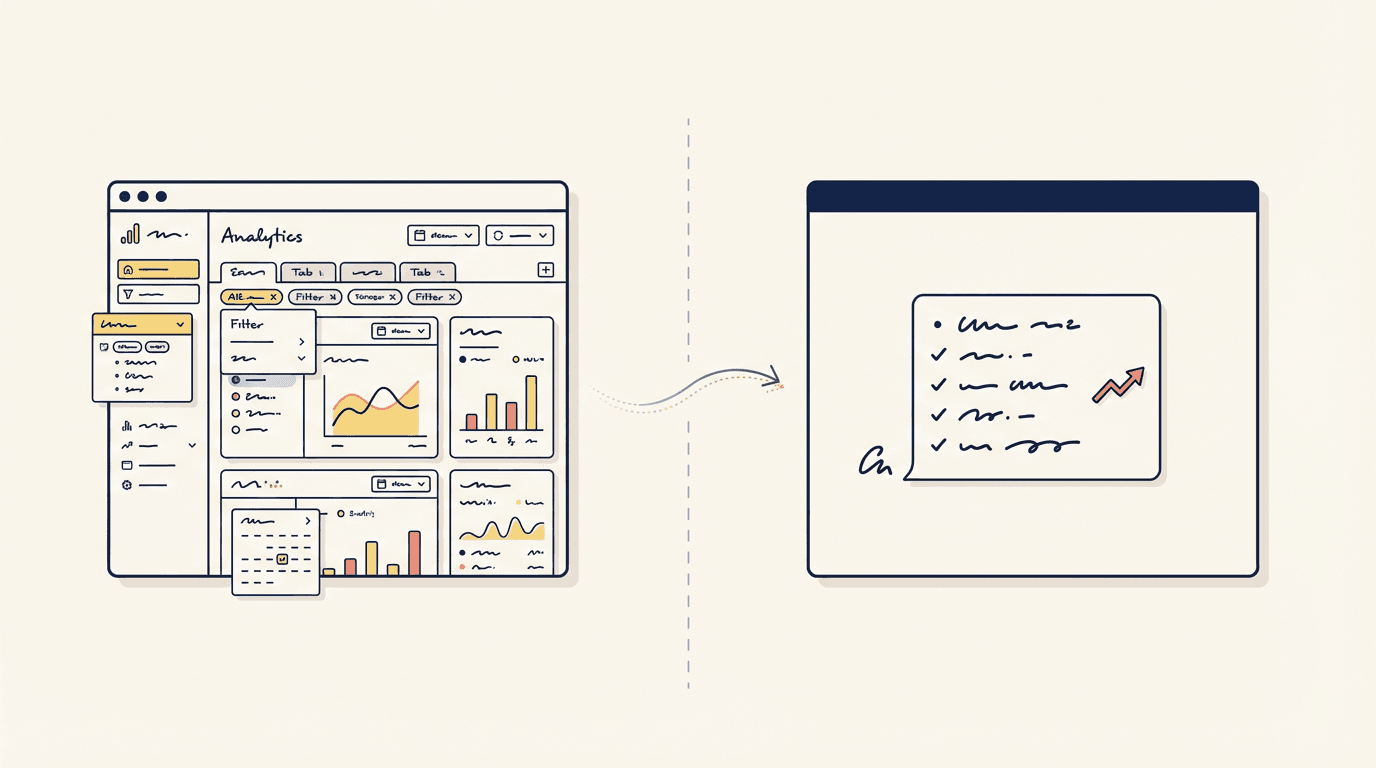
Why dashboards became obsolete the moment you had an AI teammate, and how to get more out of Toffu by asking for answers instead of interfaces.
A pattern we see with power users of Toffu is this: they connect Google Ads, Meta Ads, and three or four other sources across many client accounts and date ranges, and then ask Toffu to stitch the whole thing into an interactive HTML report. Dropdowns for the account. Tabs for the platform. Buttons to toggle the date range.
The instinct is completely understandable. For the last fifteen years, a dashboard was the best tool anyone had for looking at cross-platform marketing data. Reaching for one is muscle memory.
But that muscle memory is now working against you. The dashboard you are building is a solution to a problem that no longer exists, and it is crowding out the thing Toffu is genuinely good at.
This post is about why, and what to do instead.
What dashboards were actually for
Dashboards solved a very specific problem. A human had three jobs:
- Pull data from systems they could not query directly.
- Slice it across many dimensions until a pattern appeared.
- Decide what to do about the pattern.
Step 2 is where the UI lived. Dropdowns, date pickers, filters, toggles. Not because looking at filtered tables was inherently valuable, but because the human was the bottleneck. A person had no other way to search the space of possible slices. The dashboard was scaffolding wrapped around human cognitive limits.
The clicking was never the point. The clicking was the cost of admission.
What AI actually changed
An AI teammate does step 1 and step 2 without a UI. It can query every account, every period, every dimension, compare them, find the pattern, explain the cause, and hand you a recommendation. In one pass.
Which means the scaffolding is no longer load-bearing.
When you ask Toffu to build you a multi-account, multi-platform, multi-period dashboard, you are asking it to recreate the bottleneck it was designed to remove. You are paying for analysis and then discarding the analysis in favor of filters.
It is a horse-drawn Tesla. The reins used to matter. They do not anymore.
Why the dashboard request tends to misfire in practice
There is also a purely practical problem, separate from the philosophical one.
Building an interactive HTML dashboard that pulls live data from many accounts and platforms is one of the harder things you can ask a generative AI to do. Toffu has to write and debug interactive code and fetch large volumes of cross-account data and keep everything consistent across re-renders. More widgets mean more surfaces that can break.
So the output is fragile by construction. Users end up in frustrating loops of "fix the dropdown," "the tab lost its data," "the chart is showing last month." The output that does work is often brittle enough that a small follow-up question shatters it.
None of that fragility exists when the output is a list of findings and recommended actions. Text is robust. A five-bullet answer does not have a broken filter.
Think like a busy executive
The mental model that unlocks this shift is simple: stop thinking like an analyst, start thinking like the person the analyst reports to.
A busy executive does not open a dashboard. A busy executive reads five bullets, makes a decision, and moves on:
- CAC on Meta rose 34% week over week, driven by Account B creative fatigue.
- Google Search ROAS is up 12%, concentrated in two campaigns. Recommend scaling.
- Account C is spending 80% of budget on one ad set converting at half the account average.
- Two accounts are pacing under budget and will miss month-end targets.
- Creative refresh on Account B is the single highest-leverage action this week.
No dropdowns. No tabs. The bottom line and the action.
That is the output shape to ask Toffu for. If you find yourself reaching for a filter, it is a signal that the insight should have been handed to you directly. The filter is the residue of a world where nothing was handing you anything.
The old way vs the new way
The old way: dashboard first
- Pull data from many sources.
- Build a UI of filters and views.
- Click through filters looking for something.
- Form an opinion based on what you see.
- Decide what to do.
Steps 2, 3, and 4 were where most of the time went. They were necessary because no other tool could do them for you. The entire category of "marketing dashboard" existed to support this loop.
The new way: question first
- Ask Toffu a sharp question across all your accounts and sources.
- Receive the pattern, the cause, and the recommended actions.
- Decide what to do.
Steps 2, 3, and 4 of the old way collapse into one step that Toffu handles across more data than you could reasonably click through.
The question replaces the interface.
How to ask
The single biggest adjustment is the shape of the request. Instead of describing the artifact you want, describe the decision you are trying to make.
Dashboard-shaped request:
Build me a dashboard of all ad accounts across the last 90 days with filters
by platform and account, and tabs for campaign level and ad set level.
Answer-shaped request:
Across all ad accounts in the last 90 days, what changed materially,
what caused it, and what are the three actions worth taking this week?
The first request produces a surface to explore. The second produces a decision.
A few more examples of the answer-shaped pattern:
Pull the last 30 days across all Google Ads and Meta accounts. Tell me which
accounts are underperforming their own baseline, why, and what to do about each.
Compare this month to last month across every ad account. Give me the five
biggest movers, positive and negative, with the root cause for each.
Look at every account we manage. For each one, give me a one-line status
and the single most important action this week.
Any follow-up question you would have clicked a filter to answer, you can simply ask. The conversation is the interface.
Dashboard vs report
These two get conflated because both can be HTML artifacts with charts in them, but they answer two different jobs.
- A dashboard is a surface you explore. Its purpose is to let you navigate an unknown space. It is defined by its controls: filters, dropdowns, tabs, date pickers. The value lives in the interaction. Strip the controls and it has nothing to say.
- A report is an answer you read. Its purpose is to deliver a conclusion. It is defined by its narrative: findings, charts that illustrate a point, recommendations. The value lives in the content. It works without any clicks.
A simple test: remove every interactive control from the artifact. If what's left still tells you something useful, it was a report. If what's left is a blank frame of filters, it was a dashboard.
Dashboards earn their complexity when you do not yet know the question. Reports earn their simplicity when you do.
AI collapses the "do not yet know" state, because it can search the space for you in seconds. Most requests that used to need a dashboard now need a report. Same data, same charts, different output shape: the finding is surfaced for you instead of hidden behind a filter.
When you ask Toffu for an artifact, lean toward report. Ask the question. Let Toffu answer it in-place with charts and text. If you catch yourself describing dropdowns and tabs, you have slipped back into dashboard thinking.
When an HTML report does make sense
To be clear, HTML reports are not the enemy. They are the right tool for a few specific things:
- Client deliverables where a branded, shareable document is the output.
- Static snapshots of a period that you want to send around, not interact with.
- Recurring executive summaries where the structure is stable and the numbers refresh on a schedule.
In each of these, the report is read, not clicked. The interactivity is not what creates the value. If your use case fits here, Toffu is a great fit for producing it.
The pattern to step away from is specifically the interactive multi-account dashboard as a way to find insights. That is the work Toffu should be doing for you, not presenting to you.
The shift in one line
Stop asking Toffu for an interface. Start asking it for an answer.
You are not a dashboard user anymore. You are an operator with an analyst on call. The job is no longer to navigate data. The job is to ask sharper questions and act on the answers.
That is a bigger upgrade than it sounds like. It is most of the reason to use a teammate in the first place.
Want to see this in practice? Try asking Toffu your next cross-account question as a question, not as a dashboard spec, and see what comes back. The gap between the two shapes of output is the point.