


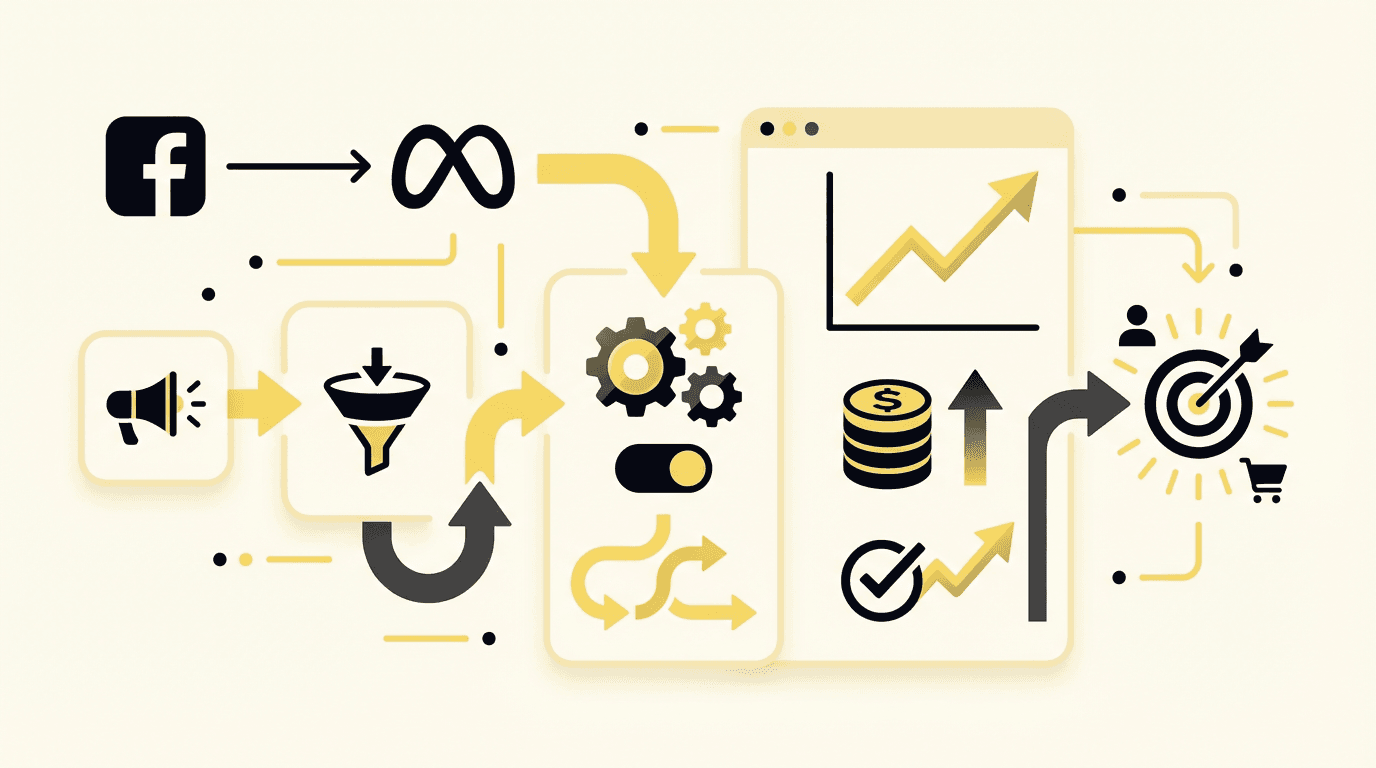
Facebook marketing hasn't been a manual job for a while. But in 2026, the gap between teams running automation and those still doing it by hand has never been wider.
Meta's algorithm — now called Andromeda — has fundamentally changed how targeting works. The ad platform is more AI-driven than ever. And the marketers winning on Meta are the ones who've stopped fighting that shift and started building systems that work with it.
This guide covers everything you need to automate your Facebook marketing in 2026: campaign rules, budget scaling, creative strategy, and where AI fits in.
What Has Changed in Meta Ads for 2026
The Andromeda Algorithm
In late 2024, Meta replaced its old targeting system with Andromeda — a deep learning model that uses your ad creative, rather than audience settings, as the primary targeting signal.
The implication: your ad copy and visuals now determine who sees your ads. Interest-based targeting is largely obsolete. Broad targeting — entire country, no age/gender filters — now consistently outperforms manually defined audiences because it gives the algorithm more data to find your buyer.
Advantage+ Is the Default
Meta's Advantage+ campaigns automate placement, targeting, and creative optimization. For most advertisers, running Advantage+ with broad targeting and a strong creative library delivers better results than manual campaigns.
What this means for automation: the role of manual rules has shifted. Instead of controlling targeting, you use automation to protect your performance thresholds — pausing what's draining budget, scaling what's working, and keeping creative fresh.
Meta Is Moving Toward GEM
Meta is building toward a Generative Ad Model (GEM): you provide a URL, budget, and brief, and the system generates the entire campaign. The marketer's job is increasingly about strategy and inputs, not campaign mechanics.
The Foundation: Define Your Funnel Metrics First
Before setting up any automation, you need to know your numbers. Every rule you build needs a threshold.
For B2B SaaS:
- Max cost per lead (demo request, free trial)
- Max cost per MQL
For B2C / e-commerce:
- Max cost per purchase
- Target ROAS (minimum 3x is a common baseline)
For mobile apps:
- Max cost per install
- App purchase ROAS
If you don't have historical data yet, use 3x as your baseline: revenue from a campaign should be at least 3x what you spent.
Core Automation Strategies
1. Pause Underperforming Ad Sets
Rule: Pause ad set with spend but no conversions
- Trigger: Spend > 1.5x your max CPA, Purchases = 0
- Example: Max CPA $50 → pause at $75 spend with 0 purchases
Rule: Pause ad set with declining CPA
- Trigger: Spend > $200, Purchases > 0, Cost per purchase > $50
Rule: Monitor sudden drops
- Trigger: CPA last 3 days > 2x CPA last 7 days
- Action: Send alert (investigate before pausing)
2. Scale Top Performers
Rule: Scale on a good day
- Trigger: Purchases > 2, CPA < $30 (today)
- Action: Set budget to $500
Tiered scaling:
- Good (CPA $20-$30): Increase budget 20% once/day
- Great (CPA < $20): Increase budget 100% once/day
ROAS-based:
- Trigger: ROAS > 3, Spend > 50% of daily budget
- Action: Increase budget 50%
Set scaling rules to run before noon to avoid late-day pacing issues.
3. Relaunch Ad Sets with Late Conversions
Rule: Restart paused ad set with new conversions
- Trigger: Purchases > 0 (last 12 hrs), CPA < $50 (last 12 hrs)
- Action: Start ad set
Rule: Restart if 7-day performance is strong
- Trigger: Impressions < 100 (yesterday), CPA < $50 (last 7 days), Purchases > 1
- Schedule: Run at midnight
4. Bid Management
Rule: Raise bid for low-impression ads
- Trigger: Impressions < 100 (last 2 hrs)
- Action: Increase bid $0.50 every 2 hours
5. Duplication for Horizontal Scaling
Rule: Duplicate winning ad sets
- Trigger: Spend > $100, Purchases > 0, CPA < $50
- Action: Duplicate ad set (once per lifetime)
Creative Automation: The Key to Andromeda
Under the old algorithm, you could run the same creative for months. Under Andromeda, stale creative directly raises your CPMs.
Refresh cadence:
- Small accounts (<$5k/month): Monthly
- Large accounts (>$20k/month): Weekly
Creative Similarity is now a metric in Ads Manager. High similarity = higher CPMs. Vary formats, not just copy.
What to include in your creative library:
- Static images (60-70% of conversions on Meta)
- Short-form video (under 15 seconds)
- Carousels (strong performance in 2026)
- Text-only static images (trending format)
- Founder/selfie-style video
- Customer testimonials
The Dynamic Creative Protocol:
- Enable Dynamic Creative (leads) or Flexible Creative (sales) at ad set level
- Upload 5-10 high-performing images and videos
- Add 2 primary text variations (short + medium)
- Add 2 headline variations
- Let Meta optimize — review AI-generated copy before launching
Native vs. Third-Party Automation
Meta's native automatic adjustments works for simple accounts with stable budgets that don't need precision CPA/ROAS control.
Third-party automation is better when:
- You need rules on exact CPA, ROAS, or spend thresholds
- You manage multiple accounts
- You want Slack/email alerts on rule triggers
- You need OR logic between conditions (Meta only supports AND)
How Toffu Handles Facebook Automation
Toffu connects directly to your Meta Ads account and lets you run automation through natural language — no rule builder required.
You can ask Toffu to:
- Monitor campaign performance and alert when CPA spikes
- Pause underperforming ad sets based on your thresholds
- Generate daily/weekly Meta performance reports to Slack
- Analyze creative library and flag fatigue signals
- Set up budget scaling rules across multiple campaigns
See the Meta Ads automation playbook
What to Set Up This Week
- Pause rule: Spend > 1.5x max CPA with 0 conversions → pause
- Scale rule: CPA < target with 3+ purchases today → increase budget 20%
- Alert rule: CPA last 3 days > 2x last 7 days → notify you
- Creative refresh calendar: Monthly for small accounts, weekly for large
- Broad targeting test: Allocate 20% of budget to Advantage+ broad, compare CPAs after 2 weeks
The teams consistently hitting CPA targets on Meta aren't working harder. They've built a system that pauses waste, scales winners, and keeps creative fresh — automatically.